- by foxnews
- 15 May 2026
FIFA's World Cup ticket defense falls apart when compared to college football and NFL playoff prices
FIFA president Infantino defends expensive World Cup ticket prices by comparing them to college football costs, but the actual numbers don't add up.
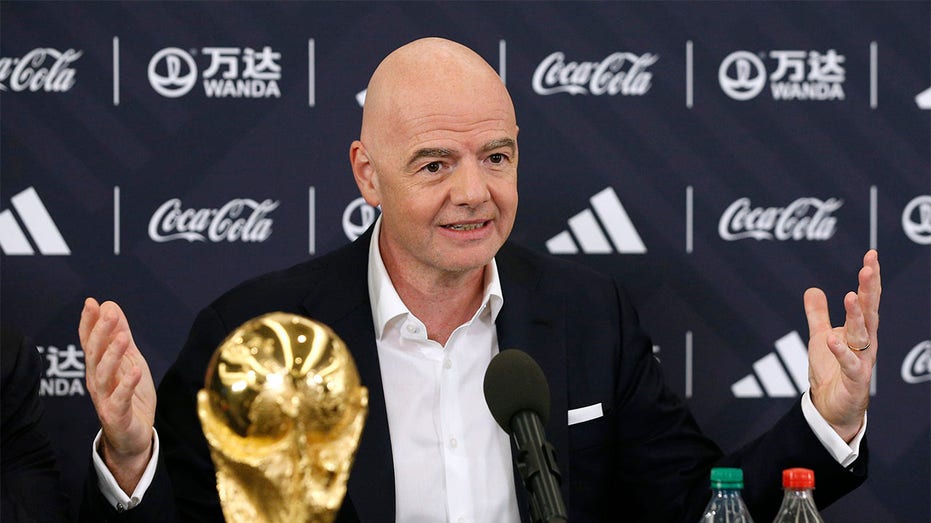
Big mistake.
Wait, what?
The problem isn't that World Cup tickets are premium, it's that his comparison is wrong.
If Infantino wanted to say World Cup tickets should be compared to the biggest events on the American sports calendar, fine. That's a fair point. The World Cup is one of the biggest sporting events on the planet.
But even that comparison doesn't make sense.
Because we're not talking about the World Cup final here. We're not talking about the semifinals. Infantino was talking about group-stage tickets. And, by the way, he wasn't even just talking about matches involving the United States or other big-name countries.
The cheapest ticket, as of Wednesday afternoon, for any opening match (meaning a country's first game in the tournament), is around $175 for Austria vs. Jordan at Levi's Stadium. Again, that's for terrible seats for one of the worst matchups of the entire group stage. The most expensive is over $1,200 to see Brazil vs. Morocco at MetLife Stadium.
Going back to his comment about college football (and "top professional games"), let's actually take a look at some data. We're even going to be generous to Infantino and look at postseason ticket prices because that's a more fair comparison, even though he implied that any college football game costs $300 (pretty sure tickets to see Purdue play Northwestern don't cost anywhere near that much, but I digress).
The better comparison for the World Cup group stage isn't the Super Bowl or the College Football Playoff National Championship. It's something like the College Football Playoff quarterfinals or NFL Wild Card weekend. The games matter, but they aren't the finals. However, one could argue those games have more importance because losing a group-stage match doesn't knock a team out of the tournament like a loss at any stage of the NFL playoffs or College Football Playoffs does.
But even with higher stakes, those tickets don't automatically start at $300, either.
Ohio State-Miami in the Cotton Bowl was $32. Oregon-Texas Tech in the Orange Bowl was $50. Indiana-Alabama in the Rose Bowl was $117. Georgia-Ole Miss in the Sugar Bowl was $219.
So, a fan could theoretically buy 5 tickets to see Ohio State play Miami for the same price as one ticket to see Austria square off against Jordan. Seriously, what is Infantino even talking about?
The same is true in the NFL, by the way.
Even Wild Card weekend, the first postseason round of America's most popular sport, didn't automatically mean every ticket started at $300.
It's hard to overstate just how incorrect Infantino was when he boldly claimed that $300 is just the price of admission to watch live sports in the United States.
If College Football Playoff quarterfinals and NFL Wild Card games can have get-in prices below $300, then FIFA probably shouldn't act like group-stage World Cup tickets under $300 are some huge bargain by American sports standards.
Some group-stage World Cup matches will be massive draws. Others won't be.
That's not an insult. It's just how tournaments work. Every World Cup match carries the brand, but not every World Cup match carries the same demand.
The World Cup final is one thing.
A random group-stage game is another.
According to The Times, Infantino said 25% of group-stage World Cup tickets are priced below $300. FIFA clearly wants that to sound reasonable. Maybe it is, depending on the match. Again, the World Cup is a premium event, and premium events cost money.
But if the defense is that "under $300" is cheap by American sports standards, that's much harder to sell.
American fans know better.
They know there's a difference between a playoff game and a championship game. They know there's a difference between Ohio State-Michigan and a Tuesday night MACtion clash. They know there's a difference between a monster World Cup group-stage draw and one that doesn't involve a host nation or global powerhouse.
That's the part FIFA is trying to blur.
Infantino also argued FIFA has to respond to the American resale market.
"We have to look at the market - we are in the market in which entertainment is the most developed in the world. So we have to apply market rates," Infantino said.
That's a more honest argument.
FIFA wants to charge high prices because it knows people will pay them. The World Cup is enormous. It hasn't been held in the United States since 1994. The tournament is expanding to 48 teams and 104 matches. Casual demand is already through the roof. Corporate demand adds another layer.
So just say FIFA believes the prices reflect the event. In most cases, that seems true. Fans might not like it, but that's capitalism at work.
Instead, Infantino tried to make $300 sound like the cost of doing business for American sports fans, and that's where he sounded completely uneducated and uninformed.
And before people try to argue that FIFA doesn't control the resale market or has no stake in it, think again.
FIFA has its own official resale platform and, according to The Times, the organization takes a 30% cut of any resale. Which means it not only makes money on the original sale, but on any subsequent sale, as well.
That means FIFA isn't just a helpless observer watching the secondary market get ridiculous from a safe distance. It's actively participating in the system.
That's what makes Infantino's comments seem more nefarious. He's trying to sell people on the idea that the tickets aren't that expensive, or even that some are a good deal, when he stands to benefit from selling as many tickets as possible at the highest price possible.
FIFA wants American fans to view World Cup pricing as normal because U.S. sports are expensive. There's some truth in that. Big events here cost big money.
But if FIFA wants to sell that argument, it should be precise.
The World Cup belongs in a premium-event category. Group-stage World Cup tickets do not need to be justified by pretending college football or NFL playoff tickets generally start at $300.
They don't.
And if FIFA is going to cite American sports to defend World Cup prices, it should probably understand how American sports pricing actually works.
Because American fans certainly do.
you may also like

- by foxnews
- 15 May 2026
Billion-dollar California cosmetics co-founder and mogul to be ordained as Catholic priest

- by foxnews
- 15 May 2026
FBI offers $200K reward for former Air Force intelligence agent accused of spying for Iran
travel
- by foxnews
- descember 09, 2016
Casino resorts in Nevada location, once packed, become ghost town as closure nears
Primm, Nevada, could become the first "gambling ghost town" as its last casino hotel is scheduled to shut down on July 4, ending decades of border town gaming.
read more