- by foxnews
- 07 Jul 2026
Bionic hands are now teaching robots to feel
ABB Robotics and PSYONIC explore using real human prosthetic touch data to train industrial robots for delicate gripping tasks in factories.
- by foxnews
- 07 Jul 2026
- in technology
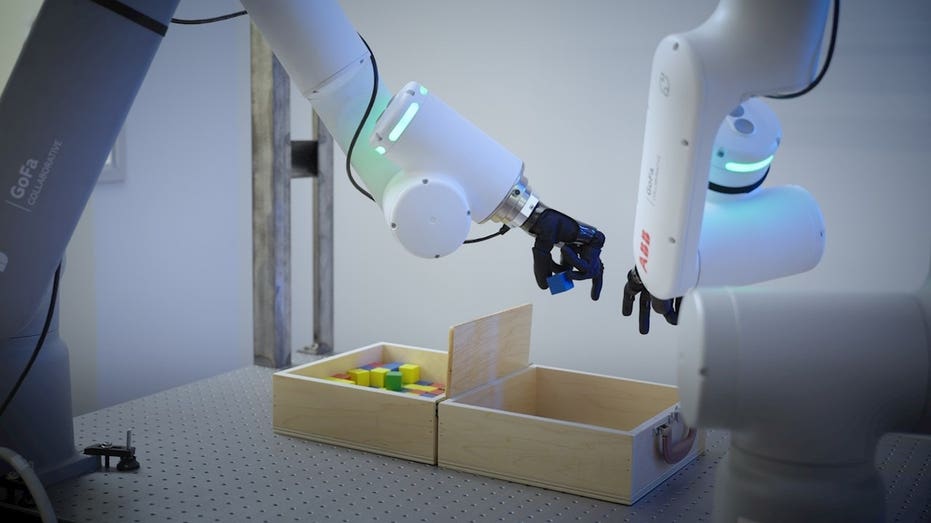
That is where a new collaboration between ABB Robotics and PSYONIC comes in. ABB Robotics is working with PSYONIC, a California bionics company, to explore whether real-world touch and motion data from human prosthetic use can help train robotic arms.
Sign up for my FREE CyberGuy Report
The collaboration centers on PSYONIC's Ability Hand and ABB's GoFa cobot. The Ability Hand was originally developed for prosthetic use. It has multi-articulating fingers, pressure sensors, vibration feedback and flexible mechanics that help it conform to irregular objects. That combination is important because human grip isn'tt one fixed action. You hold a coffee cup differently than a screwdriver. You handle an egg differently than a phone. Most of us do that without thinking about it.
For robots, that instinctive adjustment is hard. ABB and PSYONIC want to explore how movement, contact and grip-force data from the Ability Hand can help train robots to handle objects that are fragile, uneven or unpredictable. ABB's GoFa cobot brings the industrial side of the equation, offering the accuracy and repeatability needed to test those movements in a controlled way. The result could be a robot arm that learns from real human handling data, then applies that information to factory and warehouse tasks.
Industrial robots can already lift, move, weld, sort and assemble with impressive speed. However, many still struggle when a task involves subtle touch. Think about a robot picking up a soft package, a medical component or a part that shifts slightly on a conveyor belt. Too much pressure can damage the item. Too little pressure can make the robot drop it. A tiny change in angle can throw off the whole process.
The PSYONIC Ability Hand was built to help people. It uses myoelectric control, touch sensing and compliant mechanics in a lightweight design. Its sensors can detect pressure during a grip, while vibration feedback can help communicate touch back to the person using it. That same sensing ability could be valuable for robots.
ABB and PSYONIC say this work could apply across automotive, aerospace, packaging, logistics and life sciences. That makes sense. These are industries where robots already play a major role, but where delicate or variable handling can still slow things down. A robot that can better adjust its grip could help with fragile components, oddly shaped products, soft packaging or repetitive tasks that are tough on the body.
The most useful version of this technology would support people instead of simply replacing them. For example, robots could handle the repetitive gripping while workers focus on oversight, quality checks, machine setup and higher-skill work.
ABB Robotics and PSYONIC are taking a different approach to one of robotics' hardest problems: touch. Instead of training robots only in a lab, they want to use real movement and grip data from a bionic hand that people already use. That could help robots become better at delicate, variable tasks that have traditionally been hard to automate. It could also push industrial robots closer to working safely and effectively around humans in more settings. But the human side should not get lost in the excitement. If robots are going to learn from human touch, companies need to be clear about data use, workplace impact and safety testing.
Would you feel comfortable knowing a robot at work was trained using real human touch data? Let us know by writing to us at CyberGuy.com.
Sign up for my FREE CyberGuy Report
Copyright 2026 CyberGuy.com. All rights reserved.
you may also like
- by foxnews
- 07 Jul 2026
Helmet-style cockpit vision system aims to change how pilots see in low visibility
- by foxnews
- 07 Jul 2026
Helmet-style cockpit vision system aims to change how pilots see in low visibility




travel
- by foxnews
- descember 09, 2016
Discoveries that reshaped what historians knew about America's Founding Fathers
Discoveries from DNA testing, archaeology and archival research have reshaped what historians know about Jefferson, Washington and other Founding Fathers.
read more