- by foxnews
- 29 Sep 2026
Damaged fragment deemed 'unremarkable' turns out to be rare piece of Homer's 'Odyssey' history
A fragment of Homer's "Odyssey" Book 12 sat unnoticed for decades in Utrecht University's archives until a Radboud University professor recognized it.
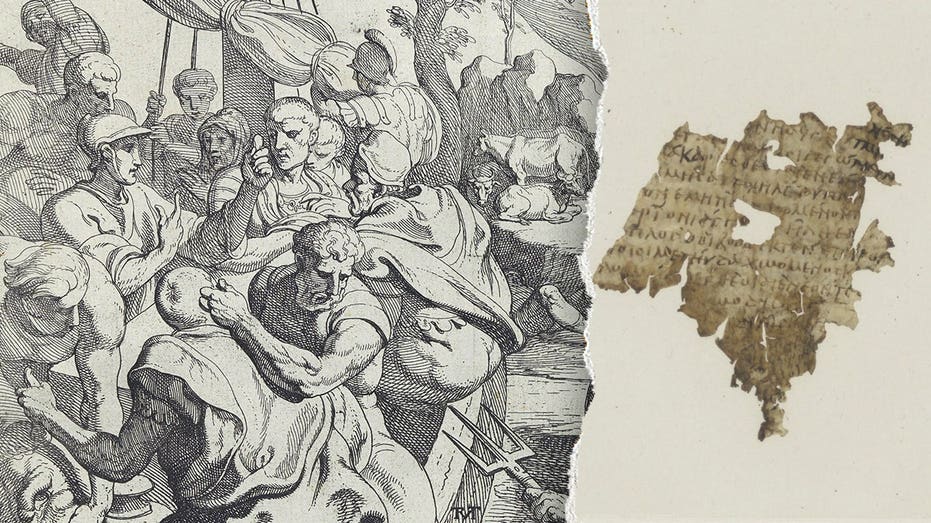
Mark de Kreij, an assistant professor of Ancient Greek and Papyrology at Radboud University, came across the unidentified parchment while studying Greek manuscripts in the university's collection.
De Kreij told Fox News Digital the fragment had originally been kept with Coptic Christian manuscripts, which he said was "probably why it was missed in the early research on the collection."
By the time he examined it, however, the still-unidentified fragment had been moved to a box containing Greek manuscripts.
Utrecht University said the fragment was first considered ordinary.
"Hidden among these, first regarded as an unremarkable 7th-century fragment, was a damaged and discolored fragment with very small, neat letters," the university said.
"De Kreij soon recognized a few words typical of the Homeric epics."
The fragment contains verses from Book 12 of the "Odyssey," including the pivotal moment when the sun god Helios discovers that Odysseus' crew killed and ate his sacred cattle.
The fragment has been dated to the third or fourth century A.D.
"There are only around 30 fragments like it worldwide," the statement said.
Though the university described the fragment as part of a "pocket edition" of the complete epic, one expert told Fox News Digital she was not convinced by that interpretation.
"The entire 'Odyssey' would require 480 pages," she said.
Dolganov noted that a parchment volume of that length would be extremely thick in such a small format, making it unlikely, in her view, that the codex contained the entire epic.
The expert also pointed to the handwriting, which she described as more casual and cursive than what she would expect in a complete literary work.
De Kreij pointed to the text preserved on both sides of the parchment as evidence that it belonged to a complete copy of the epic.
"Both sides contain passages from book 12 of the 'Odyssey,' which are nearly contiguous," he told Fox News Digital.
De Kreij said an anthology is theoretically possible, but he knows of no similar examples from the period. Complete copies of works such as the "Iliad" and "Odyssey," by contrast, have numerous parallels, he said.
Dolganov said the discovery also reflects Homer's widespread popularity in the ancient world, where his works played an important role in education.
"Homer was used to teach Greek," she added, explaining that his works were widely used as school texts around the Eastern Mediterranean.
Dolganov noted that dating ancient literary manuscripts can be difficult and imprecise, particularly in situations where scholars rely on handwriting as evidence.
"It would be important not to overstate how certain we are that this is indeed as early as the third or fourth century," she said.
"But it doesn't need to be to be a very interesting and exciting discovery."
De Kreij said the dating is based on several features of the fragment, including its codex format, parchment material, the appearance of the ink and its handwriting.
"The neat, small bookhand cannot be dated with absolute certainty, but there are good parallels from the late third and fourth century," he said.
"All such dating has to be approximate, but in the scientific edition, I cite a number of dated parallels to back up my estimate."
Dolganov also reflected on the human connection offered by the discovery.
"This is something that people held in their hand," she said. "This is something they carried with them and read, and it's a text that's also accessible to us.
you may also like

- by foxnews
- 29 Sep 2026
Airport X-ray reveals shocking illegal stash concealed beside passenger's Xbox

- by foxnews
- 29 Sep 2026
Mount Shasta climber recounts harrowing 500-foot slide, overnight crawl to safety: report



travel
- by foxnews
- descember 09, 2016
Man searching with metal detector unearths massive Viking Age fortune, shattering records
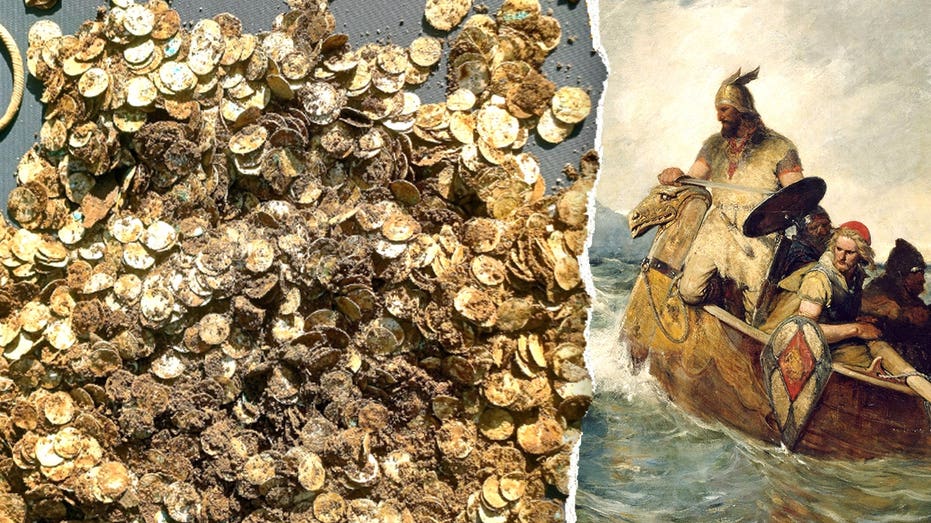
A metal detectorist in Finland uncovered an enormous Viking Age silver hoard of over 4,000 coins near Sysmä, more than doubling the country's previous record find.
read more