- by foxnews
- 22 Apr 2026
Rare Roman mosaic shows woman battling wild animals in the arena, researcher says
An ancient Roman mosaic reportedly depicts a woman confronting a leopard, marking the first known visual representation of a female beast-fighter.
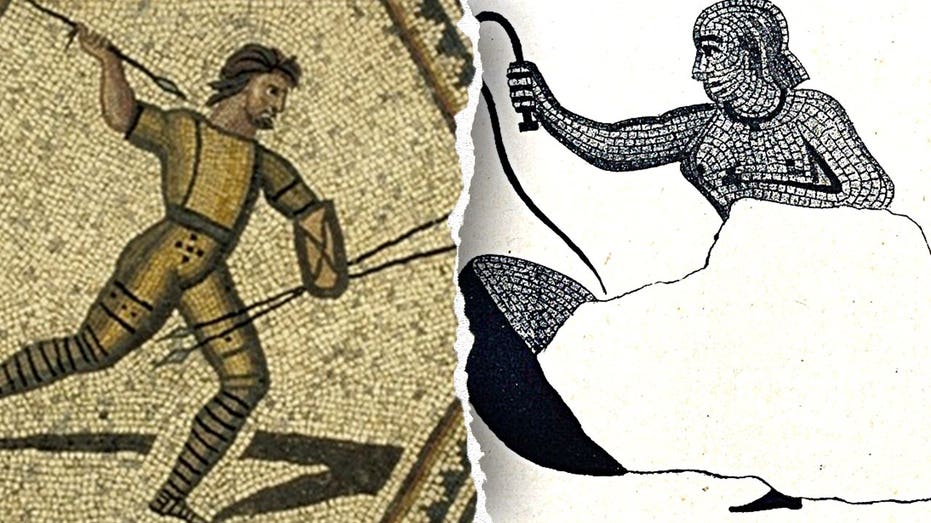
Author Alfonso Manas, a researcher in Spain, argues that the mosaic is the first-known depiction of a woman fighting an animal in the Roman arena.
The discovery adds to "documented evidence of women performing as gladiators and beast-fighters," Manas told Fox News Digital.
The most persuasive evidence that the figure is female is the fact that she was topless, Manas noted - which he described as "conclusive."
"And the strongest piece of evidence showing she is a beast-fighter is the leopard on her left, running away from her whip."
Manas added, "Thus, she is a female beast-fighter, a venatrix - the first known depiction of one of those women."
The researcher emphasized that beast-fighters and gladiators were not synonymous, however.
"To confuse them is as if we today confuse a boxer with a bullfighter - they are two completely different things," he said.
Manas said male beast-fighters were far more common, with over 1,000 known visual depictions of men compared to just one of a woman.
The historian added that women often attended shows as spectators.
Men exclusively handled organizing the games and officiating the fights - but beyond those roles, women participated in nearly every other aspect of the spectacles.
"The main difference between men and women in the arena was that men were performers, managers and spectators, whereas women were only performers and spectators," Manas noted.
The discovery also proves that females performed topless, which was meant to intrigue men.
Doing so "would help those female performers to become more popular and, thus, earn more money in their careers," said Manas.
The researcher also noted that women were banned from taking part in gladiatorial matches in 200 A.D., on the command of Emperor Septimius Severus.
It was unclear if female beast-fighters were also impacted by the ban, but Manas said his discovery suggests they were not, as the mosaic dates to roughly 250 A.D. or later.
"It adds 50 years or more, perhaps a whole century, to the history of women as performers in the arena," he said.
"This is very important.... Spectators wanted to continue seeing [women] performing in the arena."
Unlike female gladiators, who faced criticism and eventual bans, beast-fighters appear to have held a different status in Roman spectacles, Manas said.
"Whereas it was shameful for a woman, and man, to perform as a gladiator, essentially because gladiators killed fellow humans, which was always seen as reproachful."
The new research comes as discoveries from ancient Rome continue to surface.
you may also like





travel
- by foxnews
- descember 09, 2016
Rare Roman mosaic shows woman battling wild animals in the arena, researcher says
An ancient Roman mosaic reportedly depicts a woman confronting a leopard, marking the first known visual representation of a female beast-fighter.
read more